

Key Takeaways
- The right Oakville neighborhood should support your daily routine, not simply meet a target price.
- Compare commute times, home styles, maintenance needs, amenities, and future development before choosing an area.
- Older communities and newer communities can both be excellent options, but they involve different trade-offs.
- Citywide market averages are useful context, not a substitute for neighborhood and property-specific research.
- Visiting an area at different times of day can reveal details that listing photos cannot show.
Choosing a home in Oakville is about more than finding the right number of bedrooms. A home can look ideal online yet feel inconvenient once work schedules, school drop-offs, errands, parking, and weekend routines come into the equation.
For a neighborhood-level perspective, Oakville real estate experts Collective Real Estate is the Bernard Team’s local real estate website, covering home buying, selling, luxury properties, and community information across Oakville and nearby areas. Bernard Team specializes in Oakville real estate, including Old Oakville, Southeast Oakville, South Oakville, Southwest Oakville, Joshua Creek, and Glen Abbey, making its local service coverage useful when comparing how different parts of the town fit a buyer’s goals.
1. Start With Your Daily Life
Begin with the life you expect to live after moving day. Consider how often you commute, whether you want to walk for coffee or groceries, how much time you want to spend driving, and which activities matter most to your household. A longer commute may be worthwhile for a larger yard, but only if it remains manageable on an ordinary weekday.
- What is your maximum comfortable commute time?
- Do you need space for children, guests, tenants, or an aging parent?
- Would access to trails, Lake Ontario, parks, or recreation programs improve daily life?
- Do you value a quiet street, walkable shops, or quick highway access most?
2. Compare Home Types And Lot Sizes
The home influences neighborhood choice. Detached homes offer privacy, driveway space, and more outdoor area but need more maintenance. Townhomes provide a middle ground, and condos reduce exterior upkeep and offer a different market entry.
Look beyond square footage. Consider lot width, garage capacity, basement height, storage, proximity to neighbors, renovation needs, and major systems’ condition. Older detached homes might have larger lots, while newer townhouses could have better layouts and fewer repairs.
3. Compare Oakville Neighborhood Styles
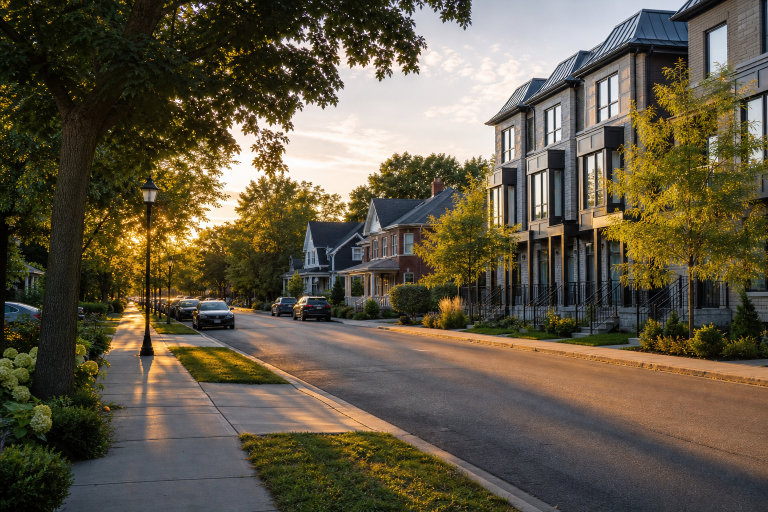
Oakville does not offer one single living experience. Established areas can have mature trees, distinctive homes, settled streets, and larger renovation decisions. Newer communities often feature contemporary floor plans, updated infrastructure, expanding retail options, and ongoing construction.
- Established areas: Consider character, landscaping, lot size, renovation scope, and the condition of older infrastructure.
- Newer areas: Consider modern layouts, energy efficiency, development activity, and the pace of expansion of nearby services.
- Lakeside areas: Consider waterfront access, village-style shopping, visitor traffic, parking, and seasonal activities.
- North Oakville areas: Consider family-oriented housing, newer schools and parks, commuting routes, and nearby future growth.
4. Check Commute And Transportation Needs
Test important routes instead of relying on a map estimate. Drive to work during your normal travel window, check access to Oakville GO and transit routes, and note traffic near highway entrances, school zones, and major intersections. Also consider parking at home, at work, and at regular destinations. A route that works on a quiet Sunday may feel very different on a weekday morning.
5. Review Parks, Shops, Schools, And Services
Convenience matters more after moving in. Check local grocery stores, pharmacies, cafés, recreation, libraries, playgrounds, trails, healthcare, and community spaces. If schools are important, verify school boundaries and enrollment with the district before buying. Also, listen and observe: road noise, trains, traffic, construction, and parking can affect comfort. Municipal plans change, so review future development plans around the property.
6. Look Beyond The Listing Price
Two similarly priced homes can have very different monthly costs. Estimate property taxes, insurance, utilities, condo fees, parking, commuting, seasonal maintenance, and repair reserves. Ask about work needed in the first two years, especially for roofs, windows, systems, drainage, and landscaping. An older home with land may suit a buyer who likes projects and has renovation funds. A newer townhome may suit someone who values predictable maintenance and more outdoor time. Neither choice is automatically better.
7. Use Market Data With Care
Market data should help you ask better questions, not create false certainty. In June 2026, the Oakville-Milton board area recorded 504 MLS® home sales, while benchmark prices varied substantially among single-family homes, townhouses, and apartments.
Focus on comparable homes that have sold in similar locations. Review days on market, active competition, condition, lot characteristics, and whether the asking price reflects recent sales. In May 2026, Oakville single-family sales increased year over year, and the reported average price reached $1.90 million, but that broad figure should not be treated as a value estimate for any one property. The May 2026 Halton housing market report offers additional local context.
8. Visit Before Making A Decision
Visit each preferred neighborhood more than once. Walk nearby streets, not only the block with the listing. Return during the morning commute, after work, and on a weekend. Check sidewalk conditions, cell service, parking, noise, traffic, and how long common errands actually take. Respectful conversations with residents can also provide a useful perspective.
9. Oakville Neighborhood Comparison Checklist
Score each area from one to five using the same criteria:
- Budget: Can you afford the home, ownership costs, and likely early repairs?
- Commute: Does travel time work on a normal weekday?
- Home style: Does the area offer the right layout, lot, and level of maintenance?
- Amenities: Are shops, parks, schools, and services convenient enough?
- Future plans: Could nearby development change traffic, views, noise, or access?
- Resale appeal: Would the location remain useful to a future buyer?
Final Thoughts
The best Oakville neighborhood is the one that supports your budget, routine, and future plans. Combine personal visits, current market research, property inspections, and professional guidance to make a decision based on how a home will work for you over time.
 Lucille Wood