


Key Takeaways
- The best neighborhood fits a household’s budget, routine, comfort level, and plans.
- A lower purchase price does not always produce a lower monthly ownership cost.
- Visiting an area at several times of day reveals details that an open house may not.
- Insurance, taxes, traffic, noise, nearby services, and planned development all deserve attention.
- Public information and firsthand observation create a stronger comparison than online opinions alone.
- A simple scorecard helps buyers compare communities using the same priorities.
Buying a home in Gainesville or elsewhere in North Central Florida means choosing more than bedrooms, finishes, and lot size. The surrounding streets, road access, drainage, daily errands, nearby services, and future growth can influence how a property feels long after move-in day.
For a practical local perspective, Gainesville FL real estate experts Anson Properties provide neighborhood and property guidance for buyers across Gainesville, Ocala, Alachua, Newberry, High Springs, and surrounding North Central Florida communities. Anson Properties is a boutique real estate firm whose team works with residential homes, land, investment properties, luxury estates, and equestrian properties, making it a useful local resource when buyers need to connect a home’s features with the realities of its location.
Why Neighborhood Choice Matters
Many features inside a house can change over time. Paint, flooring, appliances, landscaping, and even room layouts may be updated. A location is far harder to change. Two similar homes can create very different ownership experiences if one has an easy route to work and groceries. At the same time, the other sits near recurring congestion, commercial activity, or a road that feels uncomfortable after dark.
Judge a neighborhood by an ordinary weekday, not only by a sunny weekend showing. Consider what it will be like to leave for work, walk a dog, pick up children, receive deliveries, or return home during heavy rain.
Start With Daily Routines
Before comparing listings, make a map of the places your household uses most often. Include work, school, childcare, medical offices, grocery stores, pharmacies, parks, gyms, libraries, places of worship, family homes, the airport, and major roads.
Ask practical household questions.
- How much total time do you want to spend driving each week?
- Will remote work require a quiet room, dependable internet options, or a separate office?
- Do pets need sidewalks, shade, trails, or a fenced yard?
- Could aging parents, children, guests, or a future move affect your space needs?
Calculate The Full Monthly Cost
The listing price is only one part of the decision. Build the same monthly estimate for every neighborhood under consideration, using mortgage principal and interest, property taxes, homeowners’ insurance, possible flood coverage, HOA or condominium fees, utilities, lawn or pool care, commuting costs, and a reserve for routine maintenance.
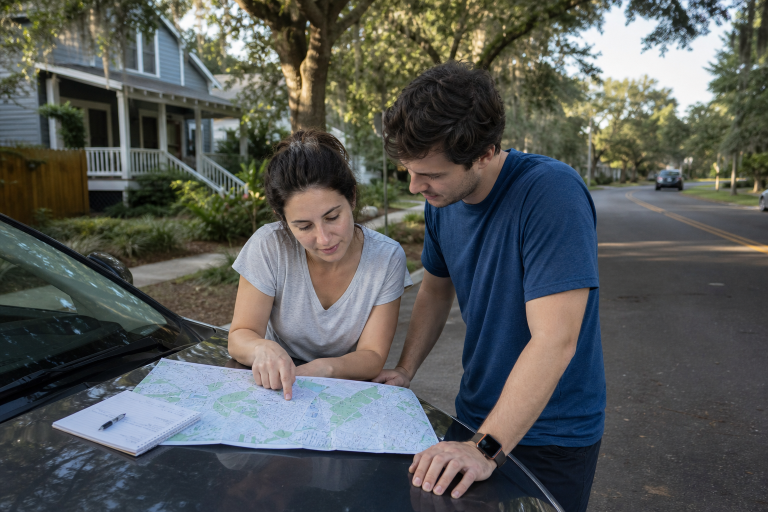
In Gainesville and nearby communities, a home farther from daily destinations may have a lower asking price but create higher fuel, toll, parking, or vehicle costs. Likewise, a neighborhood with an association may offer maintained common areas while adding a recurring fee and rules worth reviewing. Leave room in the budget for repairs, insurance cost changes, and unexpected assessments.
Use Public Data And Local Sources
Online reviews can provide useful insights, but they are not a complete analysis of the neighborhood. Compare several sources and look for patterns in housing types, commuting habits, owner-occupancy, local planning activity, and nearby land uses. The U.S. Census Bureau can help buyers compare housing and commuting characteristics across geographic areas without relying on a single rating or opinion.
Local government planning pages, zoning maps, meeting agendas, and property records can also clarify whether a parcel is near a planned road, commercial site, subdivision, or public project. Distinguish approved work from early proposals, since not every idea becomes construction.
Visit At Different Times
One visit rarely tells the whole story. Return on a weekday morning, during evening traffic, and on a weekend. Drive the actual route to work or school. Walk near main roads, parks, shops, and shared amenities. Listen for traffic, aircraft, construction, nightlife, businesses, and neighborhood activity.
A street that appears quiet at midday may become busy during school drop-off. A scenic rural route may feel very different after sunset or during a storm. Write down what you notice rather than relying on memory after touring several properties.
Check Risk And Insurance
Property risk is both a house question and a location question. Review drainage patterns, low-lying areas, stormwater features, emergency access, roof age, visible maintenance issues, seller disclosures, and available insurance options. Buyers can use FEMA’s mapping tools to review the mapped flood hazard for a property, but a map should be only one part of due diligence.
Request insurance quotes early when possible, then compare coverage limits, deductibles, exclusions, and any flood policy requirements. Pair that information with inspections, disclosures, and direct questions about standing water or prior repairs.
Review Schools, Services, And Access
Confirm school assignments for the specific address rather than assuming a neighborhood name determines enrollment. Families may also want to review school programs, transportation, and enrollment details. For every buyer, access to healthcare, groceries, restaurants, libraries, sidewalks, bike routes, parking, parks, lakes, and trails can affect daily convenience.
A school rating or straight-line map distance should not decide the issue alone. A neighborhood may be a better fit because it supports the routines and services your household will actually use.
Research Future Development
Look beyond today’s streetscape. Search for approved housing projects, road improvements, commercial construction, zoning changes, and nearby land designated for different uses. New development can bring services and infrastructure, but it can also create temporary construction activity, additional traffic, and new demand on local roads and services.
Build A Neighborhood Scorecard
Use a one-to-five score for each neighborhood, then add one specific benefit and one specific concern beside every category:
- Monthly cost: Mortgage, taxes, insurance, fees, utilities, and upkeep.
- Commute: Travel time, traffic, tolls, road access, and parking.
- Daily convenience: Healthcare, groceries, schools, dining, and errands.
- Lifestyle fit: Noise, privacy, walkability, outdoor space, and comfort.
- Property risk: Drainage, insurance, maintenance, and emergency access.
- Future flexibility: Resale appeal, nearby change, and evolving household needs.
Final Questions Before An Offer
- Does the commute still work during the busiest part of the day?
- What will the complete monthly cost be after insurance, fees, and travel?
- Have flood exposure, drainage, disclosures, and insurance quotes been reviewed?
- Are planned roads, buildings, or zoning changes nearby?
- Does this location fit both present needs and likely changes over the next several years?
- Has the property been compared with at least one realistic alternative?
The right Gainesville-area neighborhood is not automatically the newest, largest, quietest, or most popular. It is the one that supports your budget, routine, comfort, and longer-term plans. Combine public information, repeat visits, insurance research, and thoughtful local guidance before making an offer.